In this article:
- #1 Editing was destructive. On purpose
- #2 Smart Objects arrived and we unclenched our jaws
- #3 Text stopped triggering people
- #4 Undo became generous. Chaos followed
- #5 Layer styles grew up
- #6 Selection tools stopped punishing us
- #7 PSD files gained weight, depth, and commitment issues
- #8 Photoshop stopped being the finish line
- #9 Performance. If you know what I mean
- #10 PSDs lost its sacred, archival status
Gather round, boys and girls, Granny Lily has a story to tell. It does not begin with me patronizing people, though, you can relax.I meant to say nothing other than that me and Photoshop are old friends.This was many moons ago, when I was 14 and I was studying in the US, as an exchange student in high school.Leaving that trauma aside, I had the chance to work with Photoshop, and it has provided me with a strange PTSD-like experience, in retrospect.The software was not as accommodating and was a lot more direct, I tell you.
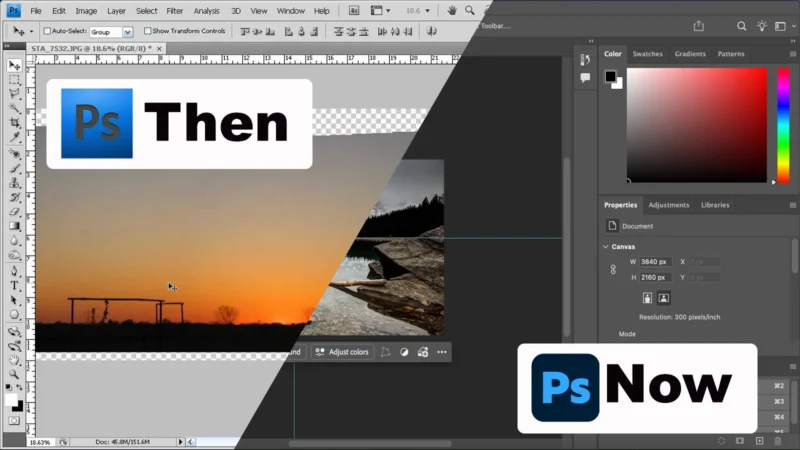
This year, Photoshop is celebrating its 36th birthday, so here is my personal opinion of what evolved in the past two decades (I am 37, actually, so we have actually grown up together).
#1 Editing was destructive. On purpose
In the early days of Adobe Photoshop, children, we didn’t have a video editor or AI tools. Editing implied making a decision that was legally binding.You have scaled something and that is it.No going back. Why, perhaps that is too bad, but the undo opportunity was humorous.
You over-sharpened and the figure got that crunchy and over-cooked appearance permanently.The use of filters was not an experiment.Commit and live with it. Till death do us part. Whatever you want to call it. Undo was there technically, but it was superficial and critical, like your ex.
I pause before every click, guys. especially when I was just learning. Like defusing a bomb, seriously. This created a generation of designers who hovered their mouse nervously and saved files every five minutes. Out of survival instinct. I’m not a designer, but habits set up camp.
#2 Smart Objects arrived and we unclenched our jaws
It was an amateur error to resize an image twice before Smart Objects.You would put one smaller than you wanted, and you would find yourself wanting it bigger and the pixels would stretch like old chewing gum, i.e. not by any means!Thank God, that was altered with Smart Objects.
And just like that you could resize, rotate, distort and rethink without ruining quality.We were all running skipping along in the fields, like freakin Maria von Trapp.The designers exhaled and everything was alright in the world.It is pleasant to be free to experiment with no plan.

Get 300+ Fonts for FREE
Enter your email to download our 100% free "Font Lover's Bundle". For commercial & personal use. No royalties. No fees. No attribution. 100% free to use anywhere.
#3 Text stopped triggering people
Text layers made me cry. You only touched them when it was really necessary.The common method of doing it was to rasterize text just in case, which really made no sense, but felt safer somehow.Naturally, one noticed a typing error five minutes later.Or would have liked the headline a little more conspicuous.Or a different font.
The current Photoshop allows the text to be editable, flexible, and surprisingly resilient.You are able to fine-tune the kerning, track, warp it, restyle it, and even correct typing errors like a civilized man.Text ceased being a trap and a part of the actual design process.
#4 Undo became generous. Chaos followed
Photoshop early days made us plan our moves.Thou hast thought three steps forth.You rescued editions like a maniac historian.Un-undo is all the way back to whole creative dead ends.This is wonderful and dangerous. You try things you would never have dared in 2004. You experiment recklessly. You undo whole moods. Creativity is more secure, yet more free.The disparity is psychological.At that time, each and every move counted.Nowadays, errors are as temporary and curiosity is promoted.Photoshop became like a strict teacher who has now become a soft grandparent who allows you to spill things.
#5 Layer styles grew up
The styles of layers began as party tricks.A drop shadow there, a bevel there, perhaps a glow, had you dared to be bold.Gradually, they established themselves as necessary instruments.Now layer styles are systems. You paste them, copy them, edit them once, and everything is updated.They can retain whole visual languages.
What once had to be done by hand now comes in a couple of seconds, you little ones.We walked so you can fly. In fact, this change altered the way people design.You no longer think of how to decorate individual elements, but in patterns.You’re welcome. It has not to do with the single button, it has to do with consistency, which is ironic, as it also contributed to making things much faster.
#6 Selection tools stopped punishing us
Selecting anything complex used to be a test of patience and eyesight. Oh, sweet summer child…Hair was a nightmare. Khm… Let me rephrase this. AAAAAAGGGHHH!!!!!
Fur was a bold move. You magnified the screen until the pixels seemed to be abstract art and poked at selections one wretched pixel at a time.In comparison, modern selection tools are even borderline psychic, believe me.You just click once, and Photoshop tells you, you would like this thing, right?Yes. That thing. Thank you. This transformed the limits to which people were prepared to go.The things which previously were energy-consuming became accessible.The entry barrier was reduced and the emotional cost of entry reduced.
Plus, if video editing is your thing, there are plenty of apps for iOS , so you can go to town with Clideo.
#7 PSD files gained weight, depth, and commitment issues
Old PSDs were simple. Some layers, perhaps a mask. That is all. PSDs created today are complex structures containing Smart Objects within Smart Objects, adjustments layers in every corner, linked assets, and naming conventions that stop making sense halfway through. Opening someone else’s PSD can feel like reading their diary. There’s power here, but also heaviness. Files take longer to load, understand, and trust. This complexity is one reason people now separate “serious design” from “quick visuals.” Not every task deserves a 300-layer file and a mild headache.
#8 Photoshop stopped being the finish line
Photoshop was the destination in 2004.You finished there. Exported once. Done. Photoshop is an intermediate nowadays.Photoshop files get transferred to social sites, websites, video editors, presentation tools, and formats that were not in existence when you were learning the Photoshop software.This changed priorities. Likewise, absolute conformity is not as important as flexibility.
Speed matters more than polish. The design is no longer an object, it’s a participant in a system. Photoshop adjusted, but users adjusted even more, learning when to use it and when to let something lighter do the job.
#9 Performance. If you know what I mean
Early Photoshop was slow, but predictably slow. Modern Photoshop can be incredibly fast or painfully sluggish depending on your hardware, drivers, memory, and whether Mercury is in retrograde. GPU acceleration made miracles possible, but also added variables. When Photoshop freezes now, it feels personal. You start bargaining. You close background apps. You promise to upgrade your machine soon. Performance stopped being just about software and became an ecosystem issue. This reality pushed many users toward browser-based or task-specific tools for quick jobs, simply to avoid the drama.
#10 PSDs lost its sacred, archival status
Perhaps the biggest change is cultural. PSDs used to be sacred files you kept forever, even if you never opened them again. Today, many PSDs are temporary scaffolding. You build them, export what you need, and move on. The file itself is no longer precious; the outcome is. This shift explains why people are comfortable with generators, templates, and shortcuts. It’s not disrespect for the craft. It’s maturity. Knowing when something needs care and when it just needs to exist long enough to do its job.