

In this article:
- Why Expand Your Artist Merchandise Beyond Art Prints? The Business Case
- The Product Ladder: A Step-by-Step Guide to Diversification
- The Artist's Challenge: Adapting Your Art for Different Mediums
- Production & Fulfillment: Choosing the Right Path for Your New Products
- Wrapping Up: Take the First Step in Your Art Product Expansion
- Frequently Asked Questions (FAQ)
You have done the hard part. You have built an audience, honed a signature style, and turned your illustrations or paintings into art prints that people actually buy. Now you are staring at your shop and asking the question every growing creative eventually hits: what is next?
This guide is your answer. We are going to walk through a strategic way to expand your artist merchandise line, moving from prints into apparel, home goods, and beyond, without turning your studio into a warehouse. The core idea is a product ladder. This step-by-step path lets you expand your art product range one manageable rung at a time, starting with what is easiest and lowest-risk.
Think of expansion less as a logistical headache and more as a creative project. You already have the art. This is about giving it new places to live. Reassure yourself that this is a manageable, highly rewarding creative process, not an overwhelming logistical burden.
Why Expand Your Artist Merchandise Beyond Art Prints? The Business Case
Expanding isn’t about selling more stuff. It’s about building a business that is more resilient, more recognizable, and more financially stable. Diversifying is also a smart move. The print-on-demand market was valued at $10.8 billion in 2025 and is projected to grow significantly to $57.5 billion by 2033, according to Grand View Research. The infrastructure to make and ship custom products has never been more accessible to independent creators.
Here is why it is worth your energy:
You build multiple artist revenue streams. When your entire income depends on one product, a slow season for prints means a slow season for your business. Adding new products spreads that risk. If prints dip but your tote bags take off, you stay steady. More streams mean more stability.
You deepen your artist branding. A print hangs on one wall in one room. But when your signature style shows up on a shirt someone wears downtown, a mug they use every morning, or a hat they throw on daily, your brand travels. Each format is a new context for your work, acting as a constant reminder of who made it. This creative entrepreneur products strategy turns your art into something people live with, not just look at.

Get 300+ Fonts for FREE
Enter your email to download our 100% free "Font Lover's Bundle". For commercial & personal use. No royalties. No fees. No attribution. 100% free to use anywhere.
You meet fans at every price point. Not everyone can spend $80 on a framed giclée. But a $6 sticker or a $25 tee? That is an easy purchase. Cheaper items let you sell artwork products to your whole audience, converting passive admirers into active customers who may return later for original works.
The Product Ladder: A Step-by-Step Guide to Diversification
The mistake most artists make is expanding at random, chasing whatever product idea feels exciting that week. A smarter approach is to climb a ladder, moving from products nearly identical to what you already make up to ones that require more adaptation and investment.
Each rung raises the production complexity a little and shifts your profit margins. Here is how the three steps compare:
| Ladder Step | Production Complexity | Typical Margin | Brand Extension |
|---|---|---|---|
| Paper & Flat Goods | Low | High | Familiar, same audience, same feel |
| Apparel & Wearables | Medium | Medium | Big leap, your art goes out into the world |
| Home & Lifestyle Goods | Medium to High | Medium | Deep, your brand enters daily routines |
Step 1: Paper & Flat Goods
This is the gentlest step up from art prints and the best place to start. Stickers, greeting cards, notebooks, postcards, and bookmarks all use the same high-resolution art files you already have. They rely on production methods close to your existing art print business.
Because the format is so familiar, there is almost no creative adaptation required. Your design translates directly to the paper or vinyl. Stickers are a creative product diversification favorite: they are cheap to produce, easy to ship, and irresistible as impulse buys.
| Quick Tip: Turn a single popular illustration into a small sticker pack. It is a low-effort, high-margin way to test which designs your audience loves most before committing them to larger products. |
|---|
Step 2: Apparel & Wearables
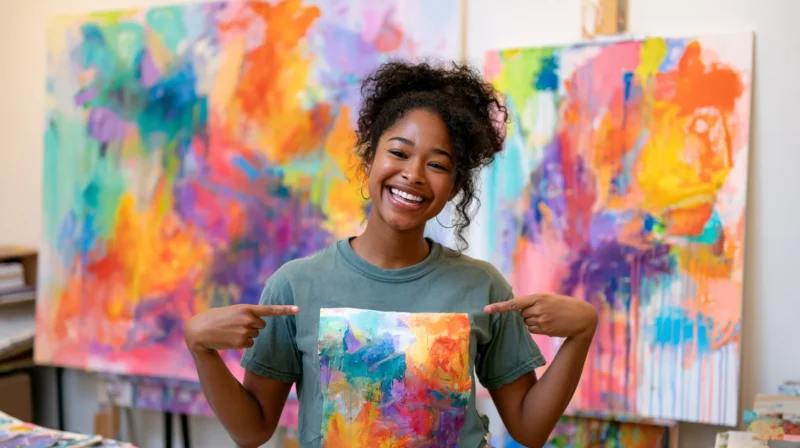
This is the major leap, which is where artist apparel becomes real. Custom-made T-shirts, sweatshirts, hoodies, and tote bags are the natural entry points. It makes sense that this category leads the industry. Custom apparel makes up a massive portion of the custom merchandise market, driven by growing consumer demand for unique, art inspired clothing, as noted by SNS Insider.
Apparel introduces new variables you did not have to think about with flat prints:
- Sizing: You must offer a range, typically from XS up to plus sizes.
- Color variations: Your design has to read well on both light and dark fabric.
- Fabric types: Cotton, polyester blends, and heavier fleece all take ink differently.
A design that looks crisp on white paper might disappear on a dark gray tee, so you will need to adapt. This is why developing merchandise for artists in the apparel space requires a bit more planning, but the payoff of seeing someone wear your work is unmatched.
Step 3: Home & Lifestyle Goods
The top rung takes your work off the wall and into everyday life. Mugs, throw pillows, phone cases, and blankets let your brand become part of a customer’s daily routine, the coffee they drink, the couch they sit on, the phone in their hand.
This category is booming. Market analysis by Grand View Research notes that the home décor segment is growing incredibly fast as more people work from home and seek to customize their spaces. For an illustrator or painter, this is a genuine opportunity to become a fixture in your customers’ living rooms and offices.
The Artist’s Challenge: Adapting Your Art for Different Mediums
The real creative work of expansion lies in the translation. Your art rarely transfers to a new product untouched. A piece designed for paper often needs reworking for fabric, ceramic, or thread. Learning how artists can make apparel and other lifestyle goods comes down to mastering the art of file adaptation.
Let’s look at a concrete example. Say you have a lush, multi-color illustration with dozens of subtle gradients. It is gorgeous as a high-quality print. However, if you want to sell artwork products across different mediums, you have to adjust:
- To screen print it on a tee, you must simplify the palette and reduce the color count. Fewer inks mean cleaner, sharper, and more cost-effective printing.
- To embroider it on a hat, you must convert it to a vector format and pare it down to bold, distinct shapes. Thread cannot reproduce fine color gradients.
The technical basics are simple to grasp once you know what to look for:
- Resolution (DPI): Prints demand 300 DPI as the standard. Apparel and other products have their own requirements, so always work from your manufacturer’s specific guidelines.
- Vector vs. raster: Raster files (like scanned paintings) are made of pixels and are perfect for detailed prints. Vector files (clean, scalable lines) are required for embroidery and bold graphic apparel.
- Templates: Every production partner provides design templates showing the exact print area and safe zones. Use them to keep your designs from being awkwardly cropped.
Think about visual consistency. When a customer lands on your store, they should see a clear visual connection between your premium prints and your casual merchandise. If your prints feature delicate botanical line art, your apparel should match that aesthetic rather than shifting to loud, blocky graphics. Consistency builds trust and makes your entire catalog feel cohesive.
Production & Fulfillment: Choosing the Right Path for Your New Products
Once you know what to make, you have to decide how to make it. For those looking to sell art online, there are two main models: print-on-demand (POD) and bulk ordering. They are not equal choices; rather, they serve different stages of your business growth.
Print-on-demand is your zero-risk testing lab. With POD, products are made only after a customer orders. There is no physical inventory to store and no upfront cost. This is the ideal way to validate demand for new custom apparel for artists.
You can easily use services like Printful to fulfill orders, while platforms like Bandcamp are excellent if you are a multi-disciplinary creator selling physical music alongside your merchandise. With a POD service like Printify, you can experiment with products like t-shirts, tote bags, or even custom-designed hats without buying a single piece of inventory.
When choosing wearables, pay attention to the decoration method. Embroidery delivers a textured, premium look that suits logos and small designs, while direct-to-garment printing works better for detailed illustrations. The best way to check the final quality is to place a sample order through your dashboard before making the product live on your artist ecommerce store.
Bulk ordering, by contrast, is for your proven best-sellers. Buying in bulk requires upfront investment but offers significantly higher profit margins. The smartest strategy is to test your ideas with POD first, then scale with bulk ordering once you know a design is a guaranteed seller.
Integrating POD with your existing storefront is incredibly straightforward. If you use a platform like Big Cartel, Etsy, or Shopify, you can link your Printify account directly. When a customer buys a shirt or a hat from your shop, the order details are automatically sent to the production partner, who prints and ships the item directly to the customer. This hands-off fulfillment lets you focus entirely on creating new art.
Wrapping Up: Take the First Step in Your Art Product Expansion
Expanding your product range is a strategic journey, not a random guessing game. The product ladder offers a safe, structured way to grow your business without taking on massive financial risk. By starting with low-risk flat goods, moving into apparel, and eventually exploring home decor, you can build a sustainable business on your own terms.
You do not have to launch a dozens-of-items collection overnight. Take one small step this week. Select one of your best-selling designs, adapt it for a new medium, and set it up as a test product using print-on-demand.
Every new item you introduce is a new opportunity to share your work with the world. A diverse artist merchandise line does more than bring in extra revenue; it helps you build a deeper, more lasting connection with the people who love your art. Take that first step today, and watch your creative business grow through thoughtful art product expansion.
Frequently Asked Questions (FAQ)
How do I decide which of my designs to put on apparel first?
Start with your proven best-sellers. Look at your art print sales data and social media engagement to see which designs resonate most with your audience. If a particular illustration is constantly being shared or purchased as a print, it is your strongest candidate for apparel or stickers.
Is print-on-demand high quality enough for professional artists?
Yes, but quality varies by provider and product. Always order samples of your own products before listing them for sale. This lets you inspect the print quality, feel the fabric, test the durability in the wash, and ensure the colors match your creative vision.
Do I need a business license to sell artist merchandise online?
This depends on your location. In many regions, you will need a basic business license or a seller’s permit to collect sales tax on physical goods. Check your local government guidelines to ensure your online shop is fully compliant.
Can I mix print-on-demand products and self-shipped prints in the same store?
Absolutely. E-commerce platforms like Big Cartel allow you to fulfill some items yourself (like limited-edition prints you sign and pack by hand) while routing other products (like t-shirts and mugs) to be fulfilled automatically by your POD partner.