

In this article:
- The Office That Looked Great and Performed Poorly
- Why Office Design Is a Business Performance Variable
- The Design Decisions That Drive Measurable Outcomes
- Common Design Mistakes and Their Hidden Costs
- A Practical Office Design Evaluation Framework
The Office That Looked Great and Performed Poorly
Two Teams, Same Headcount, Very Different Output
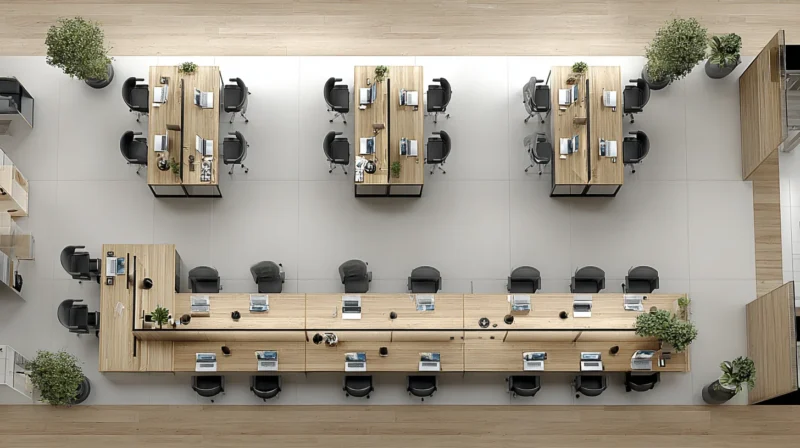
Two marketing agencies lease comparable office space in the same city. Both have teams of twenty, similar client rosters, and roughly equivalent budgets. The first occupies a fully open-plan floor-no partitions, no designated focus areas, a handful of glass-walled meeting rooms along one wall. The aesthetic is clean and modern. The second takes a slightly smaller floor, configured with a mix of collaborative zones, quiet focus areas, and informal breakout spaces positioned between workstations.
This is exactly where tools like Realmo are starting to stand out-helping teams evaluate not just the space itself, but how well it actually supports the way people work day to day.
Six months in, the first agency is managing a quiet productivity problem. Designers report constant noise interruption during deep-work tasks. Account managers hold sensitive client calls from stairwells because every meeting room is booked. Senior staff are increasingly working from home on days that require concentrated output, defeating the purpose of the space entirely. The second agency’s team, by contrast, moves fluidly between the types of work they actually do throughout the day-focused in the morning, collaborative by midday, informal in the afternoon. Same city, same lease cost per square foot. The difference was how the space was configured to match the way the team worked.
Why Office Design Is a Business Performance Variable
Space Shapes Behavior Before Anyone Sits Down
The relationship between office environment and employee output is not abstract. Research on workplace design consistently shows that physical environment influences focus, collaboration quality, stress levels, and even willingness to come into the office at all. A space that forces workers to choose between being seen and being effective – the classic trade-off in poorly designed open-plan environments – does not just create discomfort. It creates structural inefficiency that compounds across every workday.
Realmo’s advisory work with office tenants regularly surfaces a version of the same pattern: businesses that invested heavily in lease costs and buildout but allocated little thought to how the layout would support actual work patterns. The result is space that functions as a cost center rather than a productivity asset. Office design impact is not a soft benefit. It shows up in output quality, employee retention, and the willingness of top performers to spend time in the building.
The Hybrid Era Has Raised the Stakes
Hybrid work has changed the calculus significantly. When employees have a genuine choice about where to work on a given day, the office has to compete on merit. A space that offers nothing a home desk cannot – no better acoustics, no stronger collaboration infrastructure, no meaningful sense of environment – will lose that competition consistently. Research on hybrid work patterns shows that in-office attendance is highest in buildings where the design actively supports the tasks employees cannot do well at home: complex collaboration, onboarding, creative workshops, and relationship-building with colleagues and clients.
That means office design strategy is no longer just an HR concern – it is a real estate performance question. Landlords and tenants who configure space around how teams actually use it attract higher attendance, lower churn, and stronger lease renewal rates than those who treat layout as a secondary consideration after address and price.

Get 300+ Fonts for FREE
Enter your email to download our 100% free "Font Lover's Bundle". For commercial & personal use. No royalties. No fees. No attribution. 100% free to use anywhere.
The Design Decisions That Drive Measurable Outcomes
Zoning for How Work Actually Happens
The most impactful single shift in workplace layout is moving from a uniform floor plan to a zoned one. Most knowledge workers move through at least three distinct modes in a working day: focused individual work that requires quiet and concentration; collaborative work that benefits from proximity and informal communication; and social or informal interaction that builds culture and trust. A floor plan that forces all three into the same undifferentiated space serves none of them well.
Realmo consistently recommends that tenants and landlords approach office zoning as a functional brief before it becomes a design brief. Map the team’s actual workflow – what proportion of each day is spent on focused tasks versus collaborative ones, what types of meetings occur and how frequently, where noise is a problem and where it is an asset – then configure space around those patterns. That approach routinely reduces the total square footage needed while improving how the space performs, because every area is doing a specific job.
Natural Light, Acoustics, and the Physical Environment
Two physical variables outperform almost every other design consideration in their effect on employee wellbeing and productivity: natural light and acoustic management. Studies on office environment consistently find that access to daylight improves alertness, mood, and sleep quality in ways that translate directly into performance. Acoustic problems – the inability to concentrate due to surrounding noise – rank as the most commonly cited source of workplace dissatisfaction in open-plan offices, often ahead of temperature, furniture, and commute.
In one office repositioning Realmo advised on, the tenant’s utilization data showed that workstations near windows were occupied at twice the rate of identical desks in the building’s interior. The solution was not a larger floor – it was redistributing team functions so that roles requiring sustained focus were located nearest the natural light, with collaboration areas in the interior zones where noise was already higher. The reallocation required no construction and cost nothing beyond the planning exercise.
Collaboration Infrastructure That Reduces Friction
Beyond zoning and environment, collaboration space design determines whether teams can work together efficiently or spend meaningful portions of their day managing the logistics of working together. Meeting rooms that are too few, too large, or poorly equipped for hybrid calls create friction that accumulates invisibly across hundreds of interactions per week. Informal spaces that don’t exist force conversations to happen at desks – interrupting nearby colleagues and reducing the quality of both the conversation and the work it interrupts.
The practical standard Realmo applies: collaboration infrastructure should match the actual distribution of meeting types, not the aspirational version. Most teams spend far more time in two- to four-person working sessions than in large all-hands meetings – yet many office layouts invert that ratio in their room configuration. Auditing how meeting space is actually used, then reconfiguring the allocation, is one of the highest-return office optimization interventions available to most businesses without a full buildout.
Common Design Mistakes and Their Hidden Costs
Open Plan Without Acoustic Strategy
The open-plan office is not inherently a mistake – it is a mistake when deployed without an acoustic management strategy. Exposed ceilings, hard floors, glass partitions, and minimal soft furnishings create reverberation environments where ambient noise levels routinely exceed the threshold at which focused cognitive work degrades. The business cost is not just discomfort – it is the attention tax paid on every task that requires concentration, multiplied across every person and every workday.
The mitigation does not require a full redesign. Acoustic panels, soft flooring in high-noise zones, phone booths or focus pods for individual calls, and physical separation between collaboration areas and focus areas can substantially improve the environment without structural changes. Realmo advises tenants to treat acoustic design as a first-tier specification item, equivalent in importance to connectivity and lighting – not an afterthought addressed after the fit-out is complete.
Designing for Appearance Rather Than Function
The most common office design mistake is prioritizing visual impact over everyday functionality – designing spaces for photos, hiring impressions, or first client visits instead of how the team actually works day to day. Dramatic double-height atriums, oversized reception areas, and statement furniture can signal investment and culture, but they often take up valuable space that could be used more effectively for quiet rooms, small meeting areas, or additional workstations.
Space that impresses on a tour and frustrates in daily use is a real and measurable productivity liability. The design brief should start with how the team works and what environment supports that – then layer in identity and brand expression within those functional constraints, not ahead of them.
A Practical Office Design Evaluation Framework
Before committing to a layout – whether in a new lease, a renewal, or a fit-out – it’s important to work through a structured set of questions that anchor the design plan in operational reality:
- Work pattern audit.What proportion of the team’s day is focused work versus collaboration versus informal interaction? Does the layout reflect that distribution?
- Acoustic assessment.Are noise levels in focus areas compatible with sustained concentration? Is there designated quiet space for calls and deep work?
- Natural light allocation.Are roles requiring the highest cognitive load positioned nearest natural light sources?
- Meeting room calibration.Does the mix of room sizes match the actual distribution of meeting types – not the aspirational version?
- Hybrid attendance test.Does the space offer something meaningfully better than a home setup for the tasks employees are most likely to commute in to do?
- Flexibility for change.Can the layout be reconfigured as team size or work patterns shift, without a full construction project?
Businesses that work through those questions before finalizing a design brief consistently end up with space that performs better, costs less to operate, and supports stronger attendance – because the layout is doing the specific job the team actually needs it to do.